Have Their Backs – Live Firewise

5/11/15 – Every year firefighters put their lives on the line to help protect our lives, homes and businesses. By choosing to live Firewise you can help them in that fight. There are simple yet effective ways to get your home or business ready for fire season.

In a Firewise home the first 30 feet are considered Zone 1.  In Zone 1 the primary goal is to minimize the immediate dangers closest to your home (or business) by reducing the fuels that spread fire. Make sure to clear your property of dead or dying vegetation including under decks and in gutters. Next make sure to trim trees up six to ten feet from the ground. Move firewood away from homes, out-buildings and propane tanks. Consider fire-resistant material for patio furniture, swing sets etc.

Zone 2 is the next 30 to 100 feet from your home, and plants in this zone should be low-growing, well irrigated and less flammable. In this area:

  • Leave 30 feet between clusters of two to three trees, or 20 feet between individual trees.
  • Encourage a mixture of deciduous and coniferous trees.
  • Create ‘fuel breaks’, like driveways, gravel walkways and lawns.
  • Prune trees up six to ten feet from the ground.

Zone 3 is 100 to 200 feet from the home and this area should be thinned, although less space is required than in Zone 2. NOTE: Because of other factors such as topography, the recommended distances to mitigate for radiant heat exposure actually extend between 100 to 200 feet from the home – on a site-specific basis. In this area:

  • Remove smaller conifers that are growing between taller trees. Remove heavy accumulation of woody debris.
  • Reduce the density of tall trees so canopies are not touching.

For more tips and information on making your home or business Firewise visit www.firewise.org.
Several campfires left unattended

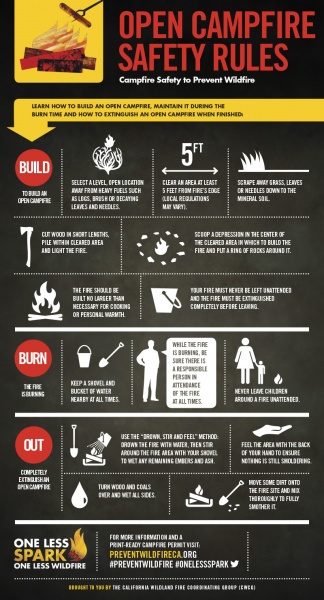
Campfire Safety Infographic Final5/4/15 – Over the weekend several campfires were reported to be left unattended. We would like to take a moment to remind all of our citizens and visitors to northeast Arizona, fires are never to be left unattended. All fires including control burns must be completely extinguished before leaving even just a short time. A small spark could ignite a devastating fire.

“If it is too hot to touch it is too hot to leave!”


Apache-Sitgreaves National Forests manage bear conflicts through special order

May 1, 2015—The ASNFs hopes implementation of a ‘new’ special order will help visitors have a safe time while camping, hiking and recreating. Due to continued bear activity in the spring and summer months in the Big Lake Recreation Area on the Apache-Sitgreaves National Forests (ASNFs) south of Springerville, AZ a Special Order was needed.

“Due to food being a constant attraction and lure to bears in the Big Lake Recreation Area campgrounds, a bear had to be terminated due to its repeated return for food. So, the public needs to respond to this Order to keep yourself, your family and bears safe while sharing this beautiful landscape,” according to Tom Osen, Apache-Sitgreaves National Forests Supervisor. “You are responsible for your safety and the safety of the bears. Please help keep our bears wild by not approaching or feeding them.”

The Order is a year round requirement for day use, as well as, for campers to store their food in wildlife resistant manner, and to throw personal garbage in bear-resistant dumpsters that are available in the Big Lake area (a map is attached). Click link below for ‘Be Bear Aware’ video that gives advice when camping: http://www.fs.usda.gov/detail/r3/recreation/?cid=stelprd3805661

Purpose of order: The purpose of this Order is to provide for public safety by minimizing adverse interactions between bears and humans.

The attached order requires that (Order 36 CFR 261.58) (click here to read the entire order: 01-15-576_Big Lake Food Storage Order)

A. All food and refuse must be stored in a wildlife resistant manner between sunset and sunrise unless attended by at least one adult person physically present within 100 feet of the items. These items included any human, pet, livestock food (except baled or cubed hay without additives), and garbage.
B. All toiletries (shampoo, lotion, etc.) must be stored in a wildlife resistant manner between sunset and sunrise unless attended by at least one adult person physically present within 100 feet of the items.
C. To the extent practical all food residue must be cleaned or burned off grills personally-owned or provided by the Forest Service. Food particles must be disposed in bear-resistant garbage receptacles.
D. Food is not to be kept or eaten in sleeping areas unless sleeping area is within an enclosed recreational vehicle or rigid-walled camper trailer.
E. No bird, squirrel, or other wildlife feeding of any kind is allowed in any campgrounds within the boundaries of the Big Lake Recreation Area.

Restricted Area:
These restrictions apply to all National Forest System lands within the boundaries of the Big Lake Recreation Area, Springerville Ranger District, Apache-Sitgreaves National Forests.

Implementation:
1. This Order will be in effect when signed and shall remain in effect until December 31, 2017 or rescinded, whichever event occurs first.
2. Any violation of this prohibition is punishable by a fine of not more than $5,000 for individuals or $10,000 for organizations or imprisonment for not more than six (6) months or both. [Title 16 USC 551, Title 18 USC 3559, 3571 and 3581].
3. This Order supersedes, rescinds, and replaces any previous order prohibiting the same acts covered by this Order.

Remember, “A Fed Bear is a dead bear”